
Architecture as Experiential Score℠
If architecture is building elevated to an art form, for ALEXANDRE KINNEY ARCHITECT PLLC this ideal can be realized when a building not only meets functional requirements, but transcends them through the intentional design of an experience, one which strives to uplift, inspire, and energize people in their daily lives.
Humans spend the majority of life inside buildings, and few art forms have the potential to immerse us as completely as architecture. In a world ever-more saturated with digital screens, virtual interactions, and automation of almost every aspect of work and life, architecture has the rare power to give people a reason to look up from their phones, to appreciate the beauty of their surroundings, and to feel the joy of being alive in the present moment.
Buildings always create an experience on multiple levels - stimulating the senses, eliciting emotional reactions, and seeming to represent ideas in subtle or overt ways. But buildings become architecture when that experience is more than just an accumulation of functional solutions. Underlying architecture is always a sense of order - one of the few timeless principles that runs from historic architecture down through the work and theories of many great modern architects. Functional problem-solving does not inherently produce an experience of order; the art of architecture lies in resolving functional requirements with a higher intention that permeates every aspect of a project, from the overall form down to the details of guardrails and wall bases.
Order does not necessarily manifest in regularity or symmetry; it can be expressed in many ways. Order comes from a strong design concept, which can be the guiding light for the many design decisions made during a project’s development. There is no formula for creating a concept — inspiration can come from anywhere and anything — but having a concept and striving to be true to it is what can ultimately give a feeling of intentionality to the experience of the built project.
To design experience is not to control it entirely. Architecture always offers a range of possible experiences, because architecture is really a score - an experiential score. Collaborating closely with the client in the pursuit of a shared vision, the experiential score takes into account many considerations - quantitative and qualitative, practical and poetic - and strives to harmonize them through architectural design. Like a musical score, architecture allows for a greater or lesser degree of interpretation when it is performed, when it is lived. Ultimately, the built work of architecture itself is a score interpreted through people’s lived experience.
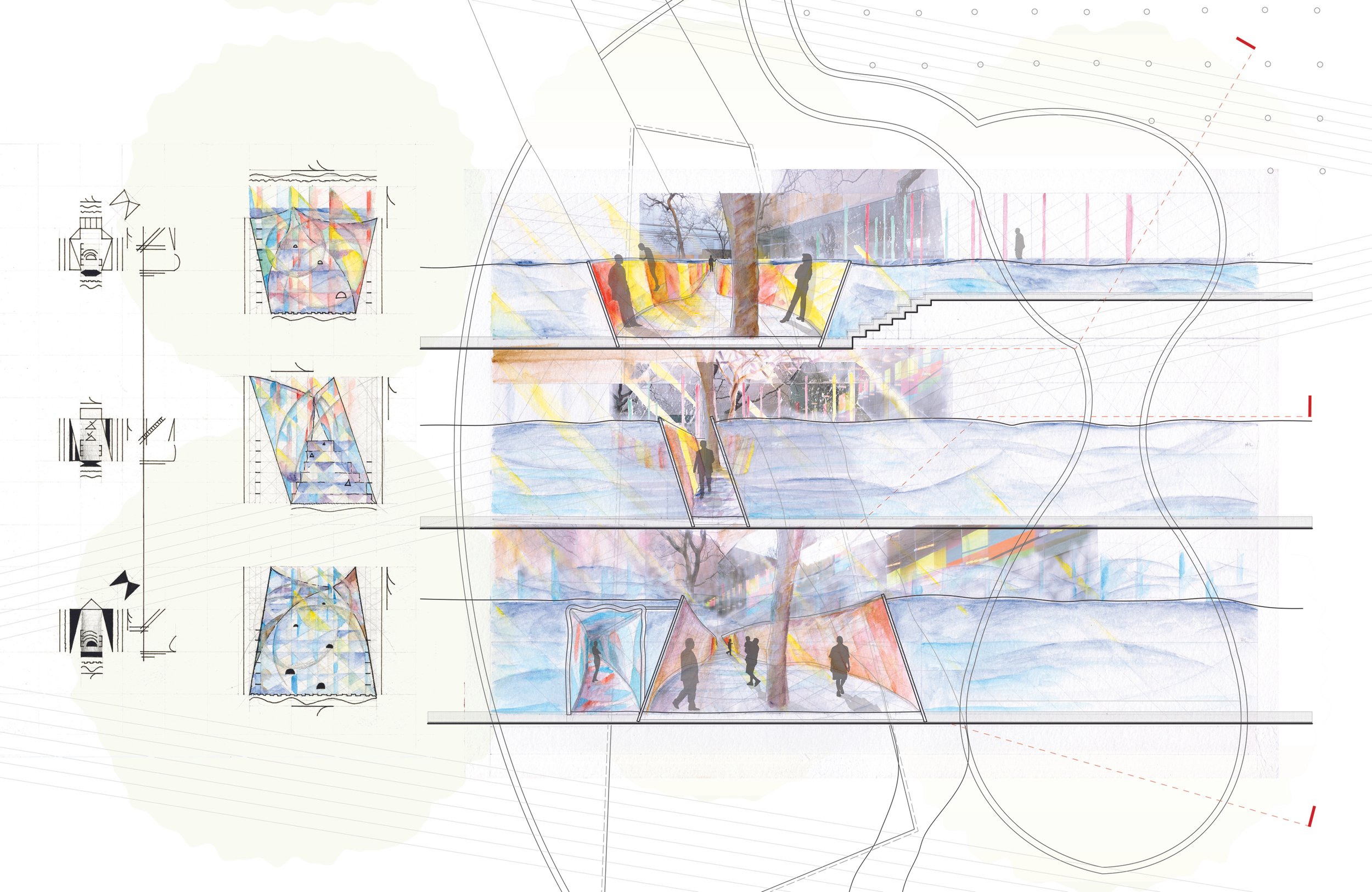
Above: Final presentation drawing of water experience installation, created as a demonstration of Alexandre Kinney’s proprietary Psychokinegraphic™ drawing language which he developed for his Bachelor of Architecture Fifth-Year Thesis. Alexandre’s Thesis laid the foundation for his theory of Architecture as Experiential Score℠, which further study and years of professional practice have only strengthened. Image © 2014 Alexandre Kinney